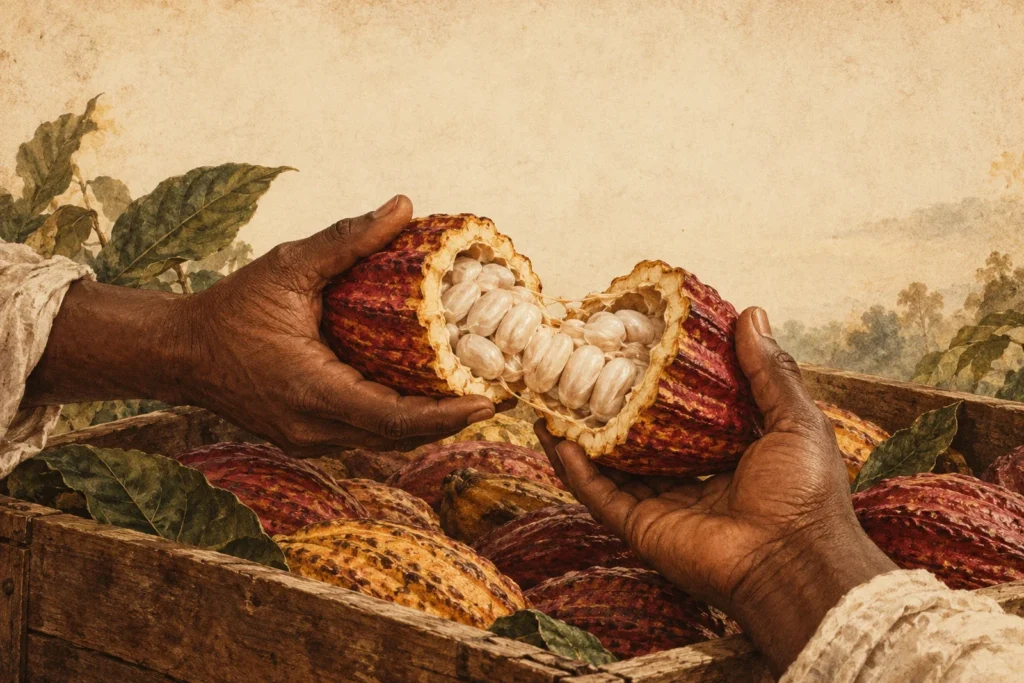
All chocolate begins with cacao, the seed of the Theobroma cacao tree. The name, given by Linnaeus in 1753, means “food of the gods.” From these bitter, purple seeds grows an industry worth over $130 billion, but the journey from raw cacao to a finished chocolate bar is longer, more complex, and more dependent on craft than most people imagine.
The Three Traditional Cacao Groups
Not all cacao is the same. The flavor, aroma and quality of chocolate depend heavily on the genetics of the tree. The trade has sorted cacao into three groups for more than a century, and the terms are still used on labels and in the specialty market every day.
The classification is a convention rather than a botanical fact. Genetic surveys published from 2008 onward found that the diversity of cacao in the Amazon basin is far greater than three groups can describe, and proposed ten or so major clusters instead. The share figures below are the traditional trade estimates, widely repeated and rarely sourced, so treat them as orders of magnitude rather than measurements.
| Variety | Character | Traditional share estimate | Key Regions |
|---|---|---|---|
| Forastero | Robust, earthy, bitter: the workhorse | Most of world supply | West Africa (Ghana, Côte d’Ivoire) |
| Criollo | Complex, fruity, floral: the rare one | A small fraction | Venezuela, Mexico, Central America |
| Trinitario | Hybrid of both: balanced, varied | The remainder | Trinidad, Ecuador, Madagascar |
Forastero is what most of the world’s chocolate is made from. It’s hardy, disease-resistant, and high-yielding, but on its own, it lacks the complexity that specialty chocolate demands. Most mass-market chocolate bars use forastero beans.
Criollo is the most prized and the most fragile. It produces beans with extraordinary flavor depth, fruity and floral, sometimes with notes of red berries or citrus, but it is susceptible to disease and produces small yields. Criollo is to cacao what Pinot Noir is to wine: difficult, rewarding, and expensive.
Trinitario is a natural hybrid that originated in Trinidad after a disease wiped out local criollo plantations and forastero was introduced. It offers a balance: more complex than forastero, more resilient than criollo. Many craft chocolate makers work with trinitario beans.
Where Cacao Grows
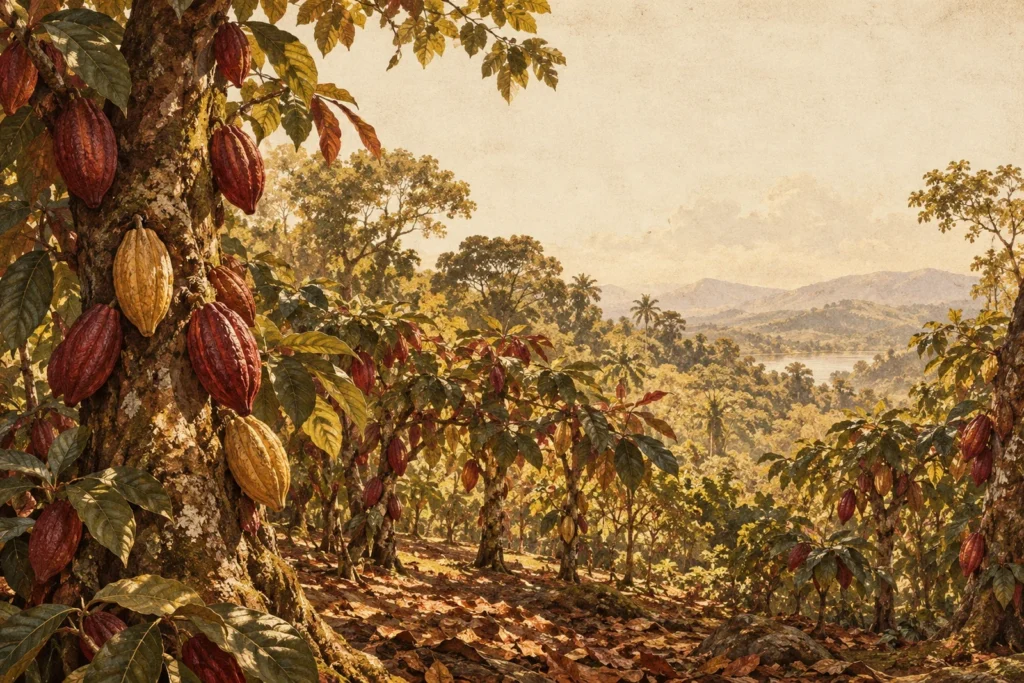
Cacao only grows within a narrow band around the equator, roughly 20° north and south. It needs heat, humidity, shade, and rich soil. The tree is surprisingly delicate: it cannot tolerate direct sun when young, is vulnerable to wind, and requires consistent rainfall.
The largest producers by volume are Côte d’Ivoire and Ghana, which together account for roughly 60% of the world’s cacao. But volume and quality are different things. Some of the most sought-after cacao comes from much smaller origins:
Ecuador: known for Arriba Nacional beans with floral and jasmine notes.
Madagascar: distinctive bright, citrusy flavor unlike any other origin.
Venezuela: home of criollo. Complex, fruity, with deep chocolate character.
Peru: growing reputation for single-origin specialty beans.
Vietnam: emerging origin, producing beans with unique, unconventional profiles.
As with tea, the concept of terroir applies to cacao. The same variety planted in different soils and climates will produce beans with different flavor profiles. This is why single-origin chocolate has become a category of its own: a bar labeled “Madagascar 70%” tastes nothing like “Ecuador 70%,” even if both are dark chocolate.
From Bean to Bar: How Chocolate Is Made
The transformation of a bitter cacao bean into a smooth chocolate bar is a multi-step process where each stage affects the final flavor.
Harvesting. Cacao pods are cut from the tree by hand. Inside each pod, 20 to 50 beans sit embedded in a sweet, white pulp.
Fermentation. The beans and pulp are piled together and left to ferment for 3 to 7 days. This is arguably the most critical step: fermentation develops the precursors to chocolate flavor. Without it, cacao beans taste astringent and flat. Over-ferment, and the flavor turns acidic.
Drying. After fermentation, the beans are spread out to dry in the sun for 1 to 2 weeks, reducing moisture content to about 7%.
Roasting. The dried beans are roasted, at a temperature and for a time that vary by maker. Roasting deepens the flavor and makes the beans brittle enough to crack and separate from their shells.
Winnowing. The roasted beans are cracked and the shells removed, leaving cacao nibs, pure cacao in its most concentrated form.
Grinding & conching. The nibs are ground into a paste (cocoa liquor), then refined and “conched”: a process of prolonged mixing and aeration that smooths the texture and mellows sharp flavors. Conching can last from a few hours to several days.
Tempering & molding. The liquid chocolate is carefully heated and cooled to precise temperatures so that the cocoa butter crystallizes correctly. Properly tempered chocolate has a glossy surface, a clean snap, and a smooth melt.
What the Percentage Means
The percentage on a chocolate bar refers to the total cacao content: the combined weight of cocoa solids and cocoa butter. A “70% dark chocolate” contains 70% cacao-derived ingredients and 30% other ingredients (usually sugar, sometimes vanilla or lecithin).
Higher percentage does not automatically mean better. A well-made 65% bar from great beans can be far more interesting than a poorly made 85%. The percentage tells you the ratio, not the quality. What matters is the origin of the beans, the skill of the fermentation, and the decisions of the maker.
Did You Know?
☞ A single cacao tree produces only enough beans for about 1 to 2 kg of chocolate per year.
☞ Cacao flowers are pollinated almost exclusively by tiny midges, flies smaller than a pinhead. Without them, no chocolate.
☞ White chocolate contains no cocoa solids at all, only cocoa butter, sugar, and milk. Technically, it is not chocolate in the traditional sense.
☞ The global chocolate industry uses roughly 4.5 million metric tons of cacao beans per year, and demand continues to outpace supply.
Frequently asked questions
What are the main types of cacao?
The trade uses three names: Forastero, robust and by traditional estimates most of world supply; Criollo, complex and rare; and Trinitario, a hybrid of the two. Genetic studies now describe many more groups, but these three are still the names on labels, and the variety affects the flavor, aroma and quality of the finished chocolate significantly.
Where does the best cacao come from?
It depends on what you consider “best.” Venezuela, Ecuador, and Madagascar are known for producing cacao with exceptional flavor complexity. However, quality depends not only on origin but on fermentation, drying, and the skill of the chocolate maker.
What does the percentage on a chocolate bar mean?
The percentage indicates the total cacao content: cocoa solids plus cocoa butter. A 70% bar is 70% cacao and 30% other ingredients (primarily sugar). Higher percentage means less sugar and a more intense cacao flavor, but not necessarily better quality.
Is white chocolate really chocolate?
White chocolate contains cocoa butter but no cocoa solids, which is where chocolate’s characteristic color and flavor come from. While it is technically derived from cacao, many purists and some regulators do not consider it true chocolate.
Why is fermentation important in chocolate?
Fermentation is where chocolate flavor begins. Raw, unfermented cacao beans are extremely bitter and astringent. During fermentation, microorganisms break down the pulp surrounding the beans, generating heat and chemical reactions that develop the flavor precursors which roasting will later activate. Without proper fermentation, no amount of processing can produce good chocolate.
Book Two, in production
The Curious Unknown History of Chocolate
The history behind the bean. Join the newsletter and you will hear the day it is out.
Cacao and tea traveled by different routes and arrived in Europe within a few decades of each other. The tea side of that story is in the guide to tea, and the book that grew out of it is The Curious Unknown History of Tea. Both belong to the collection.