Tea is the most consumed beverage in the world after water. Billions of cups are poured every day, across every continent, in every climate, by people who agree on almost nothing else. And yet most tea drinkers know remarkably little about what they are drinking.
Here is what is worth knowing.
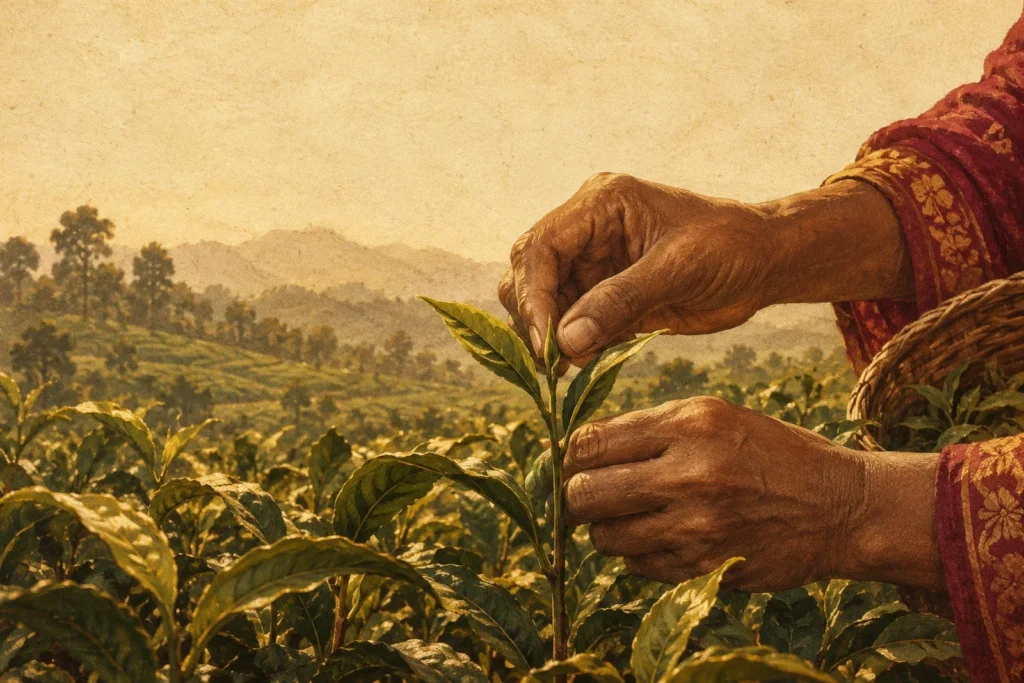
Every variety of tea (black, green, white, oolong, yellow, pu-erh) comes from a single plant species: Camellia sinensis. That fact alone surprises most people. The enormous range of flavors, aromas, and colors you find in tea is not the result of different plants. It is the result of what happens after the leaf is picked: how much oxygen it is exposed to, how much heat, how much time, and whose hands are doing the work.
The key variable is oxidation: a chemical reaction between the leaf’s enzymes and oxygen that darkens it and transforms its flavor. The same process that turns a sliced apple brown. In tea production, oxidation is controlled with extraordinary precision: stopped early for green tea, allowed partially for oolong, and let to run fully for black tea. That single variable, how far you let the leaf oxidize, is what separates a pale, grassy sencha from a dark, malty Assam.
The Six Types
There are six recognized categories of tea. Each begins with the same plant but follows a different processing path.
| Type | Part Used | Oxidation | Character | Regions |
|---|---|---|---|---|
| White | Young buds (unopened shoots) | Minimal | Delicate, floral, subtle | Fujian, China |
| Green | Young leaves & buds | None (heat-stopped) | Grassy, vegetal, fresh | China, Japan |
| Yellow | Young leaves & buds | Slight (with yellowing) | Mellow, nutty, smooth | Hunan, Sichuan |
| Oolong | Mature leaves (thicker, denser) | Partial (10 to 80%) | Complex, wide range | Taiwan, Fujian |
| Black | Mature leaves | Full | Bold, malty, robust | India, Sri Lanka, Kenya |
| Pu-erh | Mature leaves (often old-growth) | Post-fermented, aged | Earthy, deep, complex | Yunnan, China |
White tea stands apart from the rest because of what it is made from. While other teas can use a mix of buds and leaves, the finest white teas, Silver Needles being the most prized, are made exclusively from young, unopened buds harvested in early spring, before the leaf unfurls. These buds are covered in fine white hairs, which give the tea its name. Processing is minimal: the buds are simply withered and dried. No rolling, no shaping, no oxidation to speak of. The result is the most delicate tea you can drink: soft, naturally sweet, almost ethereal.
Green tea is heated quickly after picking to prevent oxidation: either steamed (the Japanese approach, producing teas like sencha and gyokuro) or pan-fired (the Chinese approach, producing teas like Longjing and Bi Luo Chun). This preserves the green color and fresh, vegetal character. The difference between Japanese and Chinese green teas is immediate and dramatic: one is savory and marine, the other is nutty and sweet. Both are “green tea,” but they barely resemble each other.
Oolong is the broadest category and arguably the most fascinating. Oxidation can range from 10% (close to green) to 80% (close to black), which means oolongs cover an enormous spectrum of flavor. A light Taiwanese Alishan oolong tastes floral and buttery. A heavily roasted Wuyi Da Hong Pao tastes smoky and mineral. They are both oolongs. The craft of the tea maker (deciding exactly when to stop oxidation, how much to roast, how tightly to roll the leaf) determines everything. If you want to understand what tea is capable of, oolong is where to start.
Black tea is fully oxidized, which gives it its dark color, strong body, and the malty, sometimes fruity flavors that most Western drinkers associate with “tea.” Assam is robust and heavy. Darjeeling is muscatel and elegant. Ceylon ranges from brisk to smooth depending on elevation. Kenyan CTC is sharp and designed for milk. They are all black teas, and they are all profoundly different. For a deeper look at why one plant produces such different results, read All Tea Comes From the Same Plant: Here’s What Makes Them Different.
Pu-erh is in a class of its own. After initial processing, the leaves undergo microbial fermentation. In the case of “raw” (sheng) pu-erh, they are then aged for years or even decades. A young sheng is astringent and bright. A 20-year-old sheng is smooth, woody, and complex in ways that no other tea can replicate. Collectors pay thousands for aged cakes, and the rarest vintages change hands for the kind of money usually spent on art. It is the wine cellar of the tea world.
Where Tea Grows, and Why It Matters
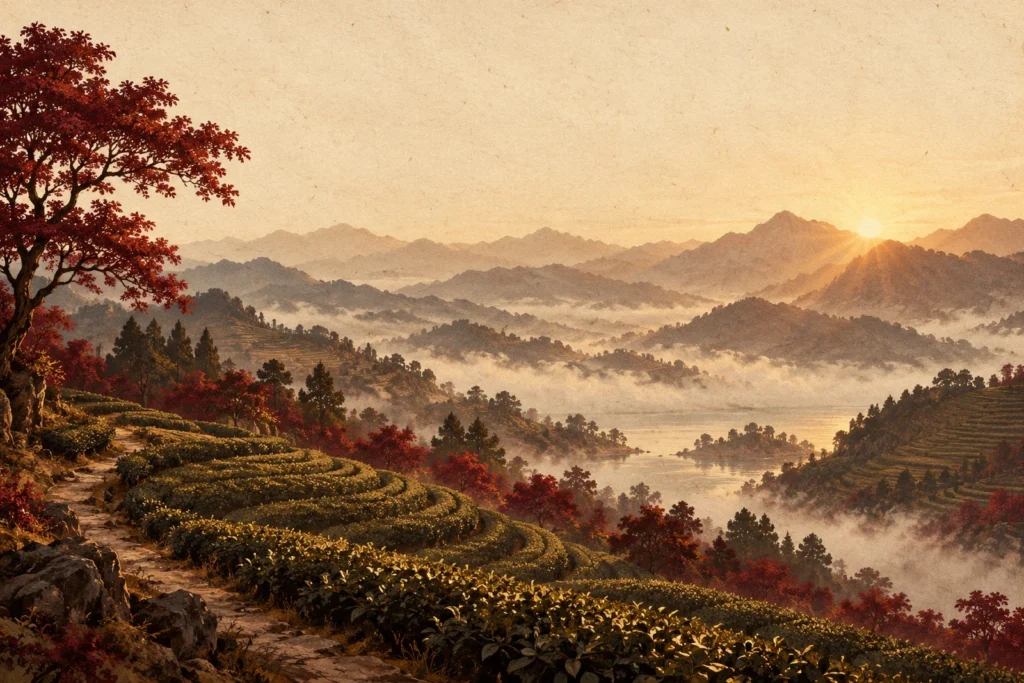
Tea, like wine, carries the fingerprint of where it was grown. The concept is called terroir: the specific combination of soil, altitude, climate, humidity, and surrounding environment that shapes the chemistry of the leaf. A tea plant grown at 2,000 meters in the Himalayas will produce a leaf with different sugars, amino acids, and aromatic compounds than the same plant grown at sea level in Kenya. The mountain tea will be slower-growing, more concentrated, more nuanced. The lowland tea will be faster, bolder, simpler.
This is why origin matters, and why the same species can produce teas that taste completely unrelated. A Darjeeling first flush (spring harvest from the Indian Himalayas) is light, floral, and almost champagne-like. An Assam from 200 kilometers away in the lowland river plains is malty, thick, and dark. Same plant. Same country. Entirely different terroir.
The world’s largest producers by volume are China, India, Kenya, Sri Lanka, and Turkey. But some of the most extraordinary teas come from tiny estates producing a few hundred kilograms a year, in places like the Wuyi Mountains in Fujian, where Da Hong Pao rocks grow mineral-rich oolongs, or the slopes of Uji in Japan, where the most prized matcha is cultivated under shade structures that alter the chemistry of the leaf. If terroir interests you, there is a whole piece on it: What Does “Tea Terroir” Mean and Why Does It Matter?
How to Brew Tea Without Ruining It
Most tea is ruined in the cup, not in the field. The two most common mistakes are water that is too hot and steeping that goes too long. Both extract bitter, astringent compounds that overpower the subtlety of the leaf. The rule is straightforward: the less oxidized the tea, the cooler the water and the shorter the steep.
| Type | Water Temp | Steep Time | Re-infusions |
|---|---|---|---|
| White | 70 to 80°C / 158 to 176°F | 3 to 5 min | 2 to 3 |
| Green | 70 to 80°C / 158 to 176°F | 1 to 3 min | 2 to 3 |
| Oolong | 85 to 95°C / 185 to 203°F | 2 to 4 min | 4 to 8 |
| Black | 95 to 100°C / 203 to 212°F | 3 to 5 min | 1 to 2 |
| Pu-erh | 95 to 100°C / 203 to 212°F | 2 to 5 min | 5 to 15+ |
Loose leaf tea almost always outperforms tea bags. The reason is physical: whole leaves unfurl and release flavor gradually, while the broken fragments inside most bags dump everything at once, including the bitter tannins. If you have only ever drunk bagged tea and think you don’t like green tea, try a decent loose leaf with proper water temperature. It is a different drink.
Caffeine, L-theanine, and Why Tea Feels Different From Coffee
All true tea contains caffeine. The popular idea that green tea has “less caffeine” than black is misleading: all Camellia sinensis leaves contain broadly similar caffeine levels. The difference in your cup comes down to water temperature and steeping time, because hotter water and longer steeps extract more caffeine. Since green tea is brewed cooler and shorter, the cup ends up with less. The leaf does not have less; you extracted less.
What makes tea genuinely different from coffee is L-theanine: an amino acid almost exclusive to Camellia sinensis. L-theanine promotes calm focus without drowsiness. Combined with caffeine, it produces what many drinkers describe as “alert relaxation”: energy without jitters, concentration without tension. This is not marketing; it is biochemistry, and it explains why tea has been the preferred drink of monks, scholars, and anyone who needs to stay awake without losing composure.
| Beverage | Caffeine per cup (240 ml) | L-theanine |
|---|---|---|
| White tea | 15 to 30 mg | Yes |
| Green tea | 20 to 45 mg | Yes (high in shade-grown) |
| Oolong tea | 30 to 50 mg | Yes |
| Black tea | 40 to 70 mg | Yes |
| Matcha | 60 to 80 mg | Yes (very high) |
| Coffee | 80 to 120 mg | No |
These are typical ranges for an ordinary cup, not fixed properties of each type. A bud-heavy white tea brewed hot and long can land well above the figure shown, which is why ranking teas by color is unreliable.
Matcha: A Category of Its Own
Matcha has become one of the most visible tea products in the world, but most people do not know what separates it from regular green tea. The difference is not cosmetic. It starts in the field. Weeks before harvest, the plants are covered with shade structures that block most sunlight. This forces the leaves to overproduce chlorophyll and L-theanine, giving them a vivid green color and a sweeter, more umami-rich flavor. After picking, the leaves are steamed, dried, and stone-ground into a fine powder.
The crucial difference: you consume the whole leaf. With regular tea, you steep leaves and throw them away. With matcha, you whisk the powder into water and drink everything. This means more caffeine, more L-theanine, and a more concentrated experience in every sense. It also means that the quality of the leaf matters even more: there is nowhere for bad flavor to hide. Ceremonial-grade matcha from Uji, Japan, can cost over €30 for 30 grams. Industrial matcha for lattes costs a tenth of that and tastes like it. There is more on this in Why Matcha Is Not Just Green Tea.
Tea vs Tisane
What most people call “herbal tea” is not tea. Chamomile, rooibos, hibiscus, peppermint and ginger are tisanes, infusions made from plants that have nothing to do with Camellia sinensis. Most contain no caffeine, none contain L-theanine, and they have none of the specific polyphenols found in tea. They are their own thing, often excellent, sometimes medicinal, but botanically and chemically distinct. Calling them “tea” is a habit of language, not a fact of nature. If this distinction interests you: Is Herbal Tea Actually Tea?
Two Words for the Same Leaf
Almost every language on Earth uses one of two words for tea: a version of “cha” or a version of “te.” The split is not random. It largely tracks to the trade routes through which each country first received tea from China. Land route: “cha.” Sea route: “te.” English, French, Spanish and Dutch, the languages of maritime powers, use the “te” form. Turkish, Russian, Hindi and Arabic, linked by overland trade, use the “cha” form. The word in your mouth is a fossil of geography. The full story is here: Why Half the World Says “Tea” and the Other Half Says “Chai”.
The History Behind the Cup
This page covers what tea is. But tea also has a story, one that involves emperors, monks, smugglers, wars, and the daily rituals of billions. That story is told in the book.
A figure sits beneath a tree, boiling water over a simple fire. Something is about to drift into the pot, something that will change the daily habits of billions. Discover in the book who this person is, and why this quiet moment matters more than it seems.
Did You Know?
☞ The world drinks approximately 3.7 billion cups of tea every day.
☞ Turkey (not England, not China) has the highest per-capita tea consumption: roughly 3.5 kg per person per year.
☞ Tea from the original Da Hong Pao mother bushes in the Wuyi Mountains has sold at auction for more than €1,000 per gram, which is more than gold.
☞ An oolong tea can be re-infused 8 or more times, with each steeping revealing different flavors from the same leaves.
Frequently asked questions
Do all types of tea come from the same plant?
Yes. Black, green, white, oolong, yellow, and pu-erh all come from Camellia sinensis. The differences are created by processing, primarily by how much the leaf is allowed to oxidize after picking. Herbal infusions (chamomile, rooibos, peppermint) are not technically tea.
What is white tea made from?
White tea is made primarily from young, unopened buds, not mature leaves. The buds are simply withered and dried with minimal handling. The finest white tea, Silver Needles (Bai Hao Yin Zhen), uses only spring buds covered in delicate white hairs.
Does green tea have less caffeine than black tea?
Not inherently. All Camellia sinensis leaves contain similar caffeine levels. Green tea typically has less caffeine per cup because it is brewed at lower temperatures and for shorter times, which extracts less caffeine from the leaf.
What is the difference between tea and tisane?
Tea comes from Camellia sinensis. Tisanes are infusions from any other plant: herbs, flowers, roots or bark. Most are caffeine free, and all are chemically distinct from tea. “Herbal tea” is a common term but botanically inaccurate.
Why does tea from different regions taste different?
Terroir (the combination of soil, altitude, climate, and local environment) changes the chemical composition of the leaf. Higher altitude and cooler temperatures generally produce more complex, nuanced teas. This is why a Darjeeling and an Assam, both black teas from India, taste nothing alike.
Is matcha the same as green tea?
Matcha is a type of green tea, but it is shade-grown, stone-ground into powder, and consumed whole rather than steeped and discarded. This produces a more concentrated flavor, higher caffeine, and significantly more L-theanine than regular green tea.
Is loose leaf tea really better than tea bags?
Generally, yes. Loose leaf uses whole leaves that unfurl and release flavor gradually, while most tea bags contain broken fragments (fannings or dust) that release everything at once, including harsh, bitter tannins. The difference is especially noticeable with delicate teas like white and green.
Book One, coming soon
The Curious Unknown History of Tea
Fifteen chapters. Emperors, monks, smugglers, wars, and rituals. The stories most people have never heard, by The Taste Storyteller.
Join the newsletter and you will hear the day it is out.
Next in the collection: the guide to chocolate, from the cacao pod to the bar.