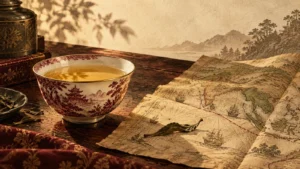
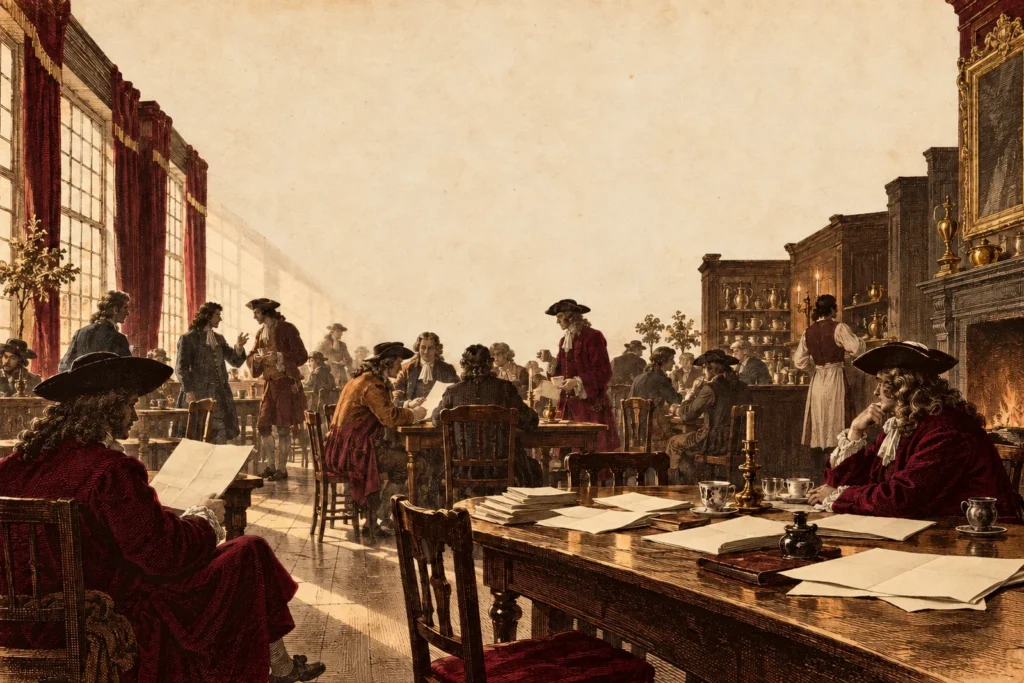
For most of the seventeenth century, London ran on coffee. By the 1660s the city had hundreds of coffeehouses, and they were where business, politics and gossip happened. Tea was a curiosity sold in the same rooms. Within a hundred and fifty years the position had reversed completely, and the reasons have almost nothing to do with which drink tastes better.
A Portuguese Queen and a Royal Fashion
In 1662 Charles II married Catherine of Braganza, daughter of the Portuguese king. Portugal had been trading with Macau for over a century and tea drinking was already established at its court. Catherine brought the habit with her, and what the queen drank the court drank.
Her dowry mattered more than her tastes. It included Bombay and Tangier, and Bombay went on to become the operating base of the English East India Company in India. The marriage that made tea fashionable also handed England the infrastructure to import it.
A Company With a Monopoly
The East India Company held a monopoly on trade with the East, and tea suited it perfectly. It was light for its value, it did not spoil on a long voyage, and demand grew every year. Coffee had no such champion: it came through Ottoman and later Dutch and French hands, and no single English institution had an interest in pushing it.
Once the Company was committed, it had every reason to make Britain a tea drinking country, and the resources to do it.
Tax, Smuggling and the Commutation Act
Tea was taxed heavily, and at its worst the duty ran well above the value of the leaf itself. The result was a smuggling industry on an extraordinary scale, moving tea through Cornish coves and Kent marshes, and an adulteration industry alongside it that bulked out cheap tea with ash leaves, sloe leaves and sheep dung dyed to match.
In 1784 the Commutation Act cut the duty dramatically and replaced the lost revenue with a window tax. Legal tea became affordable overnight, smuggling collapsed, and consumption rose across every level of society. This is the moment tea stops being a luxury and becomes a habit.
| Moment | What it changed |
|---|---|
| 1662, royal marriage | Tea becomes court fashion and England gains Bombay |
| Late 1600s onward | East India Company builds the supply and pushes demand |
| 1784, Commutation Act | Duty cut, smuggling collapses, tea reaches ordinary households |
| 1830s onward, Assam | Empire-grown tea breaks dependence on China |
Milk, Sugar and the Caribbean
British tea drinking arrived tied to sugar, and sugar came from Caribbean plantations worked by enslaved people. The two commodities grew together: cheap sugar made strong, coarse tea palatable, and sweetened tea created a market for ever more sugar. The comfortable image of the British cuppa rests on that trade, and the connection is not incidental to the story.
Growing Its Own
Everything so far depended on China, which sold tea but wanted little in return, a trade imbalance that Britain eventually addressed with opium and two wars. The other answer was to grow tea inside the empire. In the 1830s the discovery that a tea plant was already native to Assam, and the later smuggling of Chinese plants and know-how into India by Robert Fortune, made that possible.
Assam and Ceylon tea was strong, cheap and plentiful, and it suited the milk and sugar habit perfectly. By the late nineteenth century the British were drinking tea grown by British companies on British-controlled land, and the choice was effectively settled.
☞ The word for the drink followed the trade route rather than the drink itself, which is why half the world says tea and the other half says cha. That split is explained in why half the world says tea and the other says chai.
☞ The tea break entered industrial working life in the nineteenth century and was formalized in many workplaces during the twentieth, which is also where the confusion between afternoon tea and high tea begins. That is covered in afternoon tea versus high tea.
Frequently asked questions
Did Britain really drink coffee before tea?
Yes. Coffeehouses appeared in England in the 1650s and became central to London life well before tea was widely available. Tea was sold in those same coffeehouses as a novelty. The reversal took place over the following century and a half.
Who introduced tea to Britain?
Tea was already being traded in small quantities before 1662, but Catherine of Braganza is credited with making it fashionable at court after her marriage to Charles II. Court fashion then spread downward through wealthy households.
Why do the British add milk to tea?
Several explanations circulate, including protecting delicate porcelain from hot liquid and softening the strong, tannic character of Assam and Ceylon teas. The habit was established by the eighteenth century and became fixed once strong empire-grown tea dominated the market.
Does Britain drink more tea or coffee today?
Tea remains deeply established, but coffee has recovered substantial ground since the growth of the coffee shop chains from the 1990s onward, particularly among younger drinkers. The reversal of the seventeenth century has been partly reversed again.
Back to the full guide: everything worth knowing about tea.