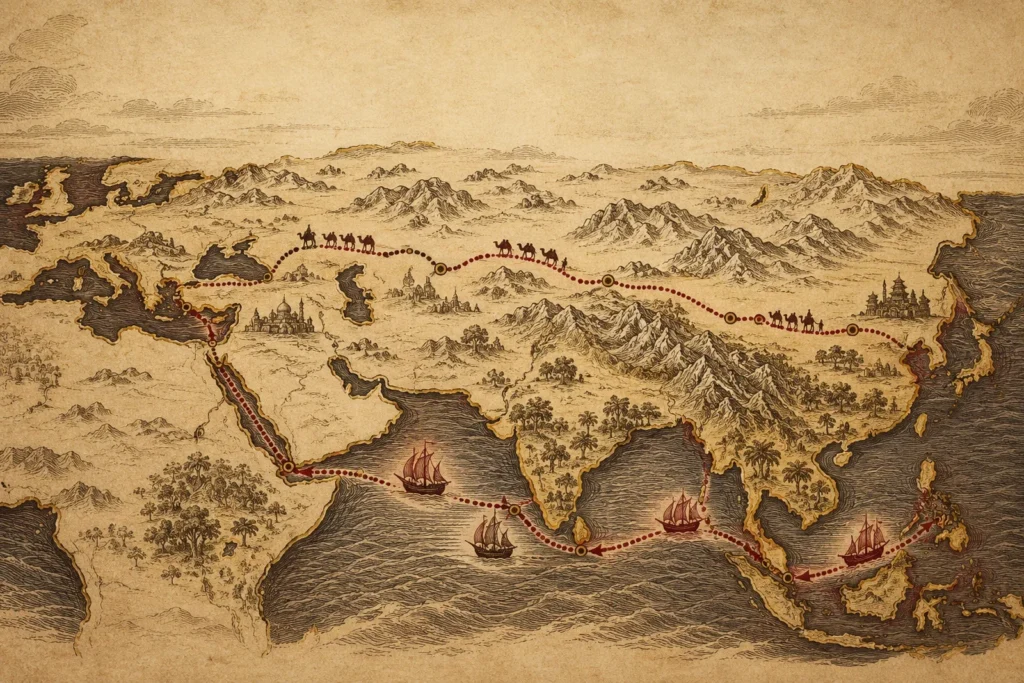
Almost every language in the world uses one of two words for tea: a version of “cha” or a version of “te.” The split is not random. It largely tracks to the trade routes through which each country first received tea from China, overland or by sea. Countries that imported tea by land say “cha.” Countries that imported it by ship say “te” or “tea.”
One Character, Two Pronunciations
The Chinese character for tea is 茶. In Mandarin and Cantonese, it is pronounced chá. But in the Hokkien dialect, spoken in the southern coastal province of Fujian, the same character is pronounced tê.
Fujian was the epicenter of China’s maritime tea trade. The Dutch, who were among the first Europeans to buy tea in bulk, dealt primarily with Hokkien-speaking merchants in the port of Xiamen (Amoy). They adopted the Hokkien pronunciation and carried it west. From Dutch thee came English tea, French thé, Spanish té, and German Tee.
Meanwhile, countries that received tea through overland caravan routes, the Silk Road and its tributaries, adopted the Mandarin/Cantonese pronunciation. That is why Turkish speakers say çay, Russians say chai, Hindi speakers say chai, Arabic speakers say shay, and Swahili speakers say chai.
The Sea Route: How “Te” Traveled West
In the early 1600s, the Dutch East India Company (VOC) established trading posts across Southeast Asia. Fujian’s ports were their primary source of tea. The Dutch brought crates of tê back to Amsterdam, and from there the word and the drink spread across Western Europe.
The English adopted it from the Dutch. The French, Spanish, Italians, and Scandinavians all developed their own versions. Even Malay (teh) and some West African languages trace their word for tea back to this same Hokkien root.
In each case, the word arrived by sea, in wooden crates aboard merchant ships.
The Land Route: How “Cha” Traveled Overland
Tea had been traveling overland long before it reached European ports. Compressed into bricks for durability, it moved by horse and camel along caravan routes stretching from Yunnan through Central Asia to Persia, the Middle East, and eventually Russia and Eastern Europe.
These traders spoke Mandarin or Cantonese. The word they carried was chá. Every country along the overland route adopted some version of it.
The pattern is remarkably consistent. If you draw a line across a map, the division is almost geographic: maritime nations to the west and south say “te”; continental nations to the north and east say “cha.” There are very few exceptions.
The Word for Tea Around the World
| “Te” Family (Sea Route) | Word | “Cha” Family (Land Route) | Word |
|---|---|---|---|
| English | tea | Hindi | chai |
| French | thé | Turkish | çay |
| Spanish | té | Russian | chai (чай) |
| Dutch | thee | Arabic | shay (شاي) |
| German | Tee | Persian | chay (چای) |
| Malay | teh | Swahili | chai |
| Finnish | tee | Mongolian | tsai (цай) |
The Exceptions
A few languages break the pattern. Portuguese uses chá despite being a maritime nation, because Portugal traded directly with Macau and Canton, where the Cantonese pronunciation prevailed, before the Dutch established the Hokkien trade. Polish uses herbata, derived from Latin herba (herb), which suggests the drink was first understood as a herbal infusion rather than a specific product.
These exceptions do not weaken the pattern. They confirm how precisely the word for tea tracks historical trade relationships.
A Word That Carries History
Few words are as revealing as the word for tea. It tells you which port your ancestors traded with, whether goods arrived by ship or by camel, and which Chinese dialect the local merchants spoke. It is a one-word history lesson, hiding in plain sight and spoken without thought every time someone asks for a cup.
How tea spread across the world, and how it changed every culture it touched, is the subject of The Curious Unknown History of Tea. And if you want to understand why all tea comes from the same plant, the story starts with a single species and the hands that shape it.
Did You Know?
☞ The Dutch East India Company (VOC) was the first to bring tea to Europe in large quantities, sourced from Hokkien-speaking merchants in Xiamen.
☞ Portugal uses “chá” instead of “tea” because it traded with Canton and Macau before the Dutch established the Hokkien route.
☞ The Chinese character 茶 is often read as grass above, wood below and a person in between, a reading that makes the plant the place where nature and people meet.
Frequently asked questions
Why do some people call tea “chai”?
“Chai” comes from the Mandarin/Cantonese pronunciation of the Chinese character 茶 (chá). Countries that received tea through overland trade routes (including India, Turkey, Russia, and the Middle East) adopted this pronunciation. In Hindi, “chai” simply means tea, not a specific spiced variety.
Is “chai tea” redundant?
Technically, yes. Since “chai” already means “tea,” saying “chai tea” is like saying “tea tea.” The phrase became common in English to distinguish spiced Indian-style tea (masala chai) from other types. A more accurate term would be “masala chai”, which means spiced tea.
What is the origin of the English word “tea”?
The English word “tea” comes from the Dutch “thee,” which was adopted from the Hokkien Chinese pronunciation “tê.” The Dutch were the first major European importers of tea, trading through the southern Chinese port of Xiamen where Hokkien was spoken.
Why does Portuguese use “chá” instead of “tea”?
Portugal established trade contacts with Macau and Canton before the Dutch dominated the Hokkien route. Portuguese merchants dealt with Cantonese-speaking traders who pronounced the word as “chá,” and that pronunciation stuck.
Back to the full guide: everything worth knowing about tea.