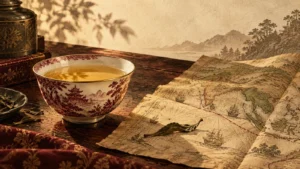
Terroir is the argument that where something grows leaves a mark you can taste. The word comes from wine, and it transfers to tea better than to almost anything else, because tea is one plant grown across an enormous range of altitudes, soils and climates, and the differences survive all the way into the cup.
Altitude
Height is the single most discussed factor. Higher gardens are colder, so the plant grows more slowly and the leaf has longer to accumulate the aromatic compounds that give a tea its character. High-grown teas are typically described as more perfumed and more complex; low-grown teas as fuller and stronger but simpler.
Sri Lanka formalizes this on the label. Its teas are sold as low grown, mid grown and high grown, and the categories describe genuinely different cups rather than a quality ladder.
Soil and Geology
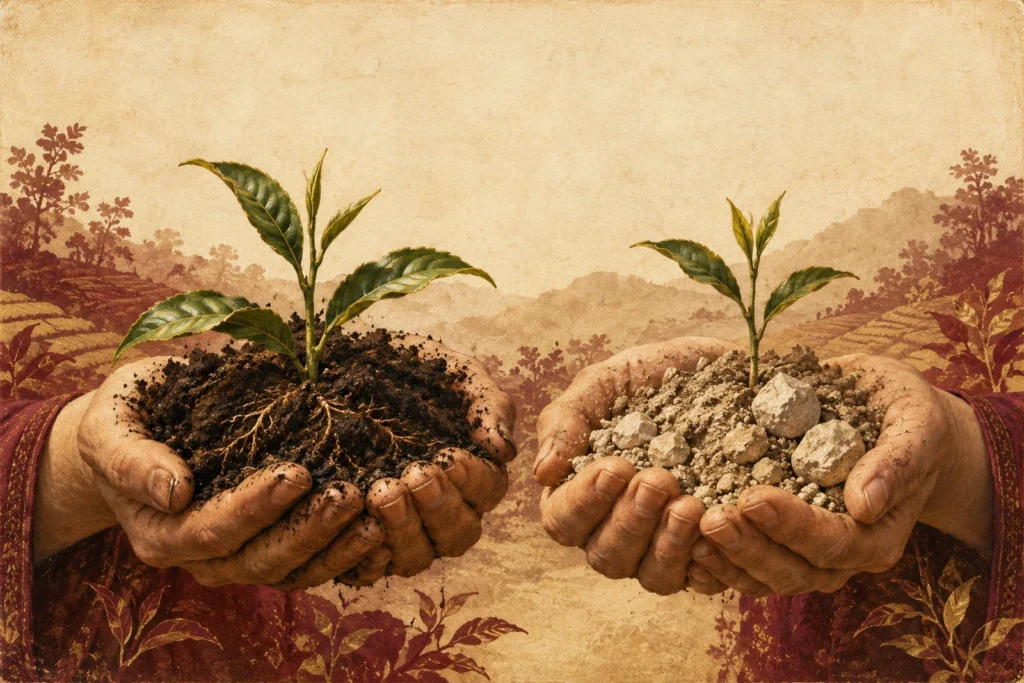
Tea wants acidic, well-drained soil, and beyond that the local geology shapes the result. The rocky Wuyi mountains in Fujian give their oolongs a mineral quality the Chinese describe as rock flavor, and that character is tied so tightly to the specific cliffs that teas from just outside the area are sold, and priced, as a separate thing.
Climate, Mist and Shade
Many famous gardens sit where cloud and mist are habitual. Diffuse light slows growth and changes the balance of compounds in the leaf, generally raising the sweet and savory amino acids relative to the bitter polyphenols. That is why so many celebrated gardens are in places that look permanently overcast.
Shading can also be imposed deliberately rather than waited for, which is the technique behind gyokuro and matcha.
When It Was Picked
The same bush yields different tea across the year. Darjeeling sells its harvests as flushes: the first flush of early spring is light, brisk and green in character; the second flush of early summer is rounder and carries the muscatel note the region is known for; the monsoon and autumn flushes are different again.
In China, the most valued green teas are picked before the Qingming festival in early April, when growth has been slow and the buds are small and concentrated. A week’s difference in picking date can change the price several times over.
| Origin | Conditions | Associated character |
|---|---|---|
| Darjeeling, India | High Himalayan slopes, cool, misty | Light, floral, muscatel in second flush |
| Wuyi, Fujian | Rocky cliffs, mineral soils | Roasted, mineral, long finish |
| Uji, Japan | River valley, often shaded | Sweet, savory, marine |
| Nuwara Eliya, Sri Lanka | Highest grown on the island | Delicate, brisk, pale liquor |
| Assam, India | Hot, humid lowland floodplain | Malty, strong, full bodied |
Cultivar and Craft
Terroir does not act alone. The cultivar planted, and the skill of whoever processes the leaf, matter just as much. A great garden can be ruined by careless firing, and the same leaf can be made into several different teas, as explained in all tea comes from the same plant. Terroir sets the raw material; processing decides what is done with it.
Does It Survive the Cup?
In blended supermarket tea, largely no. Blending exists precisely to erase variation and deliver the same cup every week, which is a real skill in its own right and the opposite of a terroir argument. In single origin tea, the differences are obvious even to a beginner tasting two gardens side by side.
☞ Some producing regions now use protected origin schemes of the kind familiar from wine and cheese, with Darjeeling among the best known examples.
Frequently asked questions
Does tea have terroir like wine?
Yes, in the sense that altitude, soil, climate and harvest timing produce consistent and recognizable differences between origins. The comparison is imperfect because tea undergoes far more processing after harvest than wine grapes do.
Is high altitude tea better?
Not better, different. High grown teas tend to be more aromatic and delicate, low grown teas stronger and fuller. Which one suits you depends on the cup you want, and strong low grown tea is exactly right for a mug with milk.
What is a flush?
A flush is a harvest period, the new growth that appears after a dormant or rested stretch. Darjeeling’s first and second flushes are the best known, and they produce noticeably different teas from the same bushes.
Can you taste terroir in a teabag?
Rarely. Most bagged tea is blended from many gardens and often many countries, specifically so the flavor stays constant. Single origin loose leaf is where origin differences become easy to notice.
Back to the full guide: everything worth knowing about tea.