Black, green, white, yellow, oolong and pu-erh tea all come from one plant: Camellia sinensis. There is no black tea bush and no green tea bush. What separates a delicate silver-needle white from a malty breakfast black is not botany but what happens to the leaf in the hours and days after it is picked.
One Species, Two Varieties
The species has two varieties that matter commercially. Camellia sinensis var. sinensis is the small-leafed Chinese variety: hardy, tolerant of cold, slow growing, and associated with delicate teas. Camellia sinensis var. assamica is the large-leafed variety found in Assam and much of South and Southeast Asia: vigorous, heat loving, and associated with strong, brisk, malty cups.
On top of those two varieties sit hundreds of cultivars, selected and propagated the way grape or apple varieties are. A Japanese garden planted with the Yabukita cultivar and a Taiwanese garden planted with Qing Xin are both growing the same species, and the results taste nothing alike.
What Oxidation Actually Is
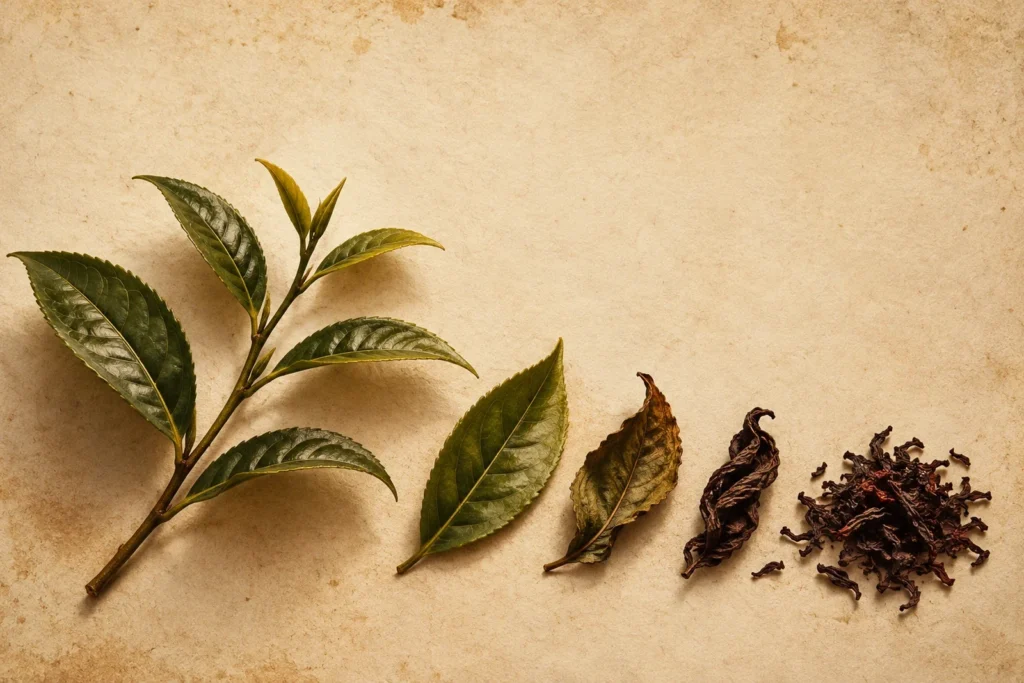
Tea leaves contain polyphenols and the enzyme polyphenol oxidase, kept apart while the leaf is intact. Bruise or roll the leaf and the two meet in the presence of air. The polyphenols begin to change, the leaf darkens, and the flavor moves from grassy and vegetal toward malty, fruity and woody.
This is the same reaction that turns a cut apple brown, and the entire craft of tea making is the control of it. Heat stops it: a quick pass through a hot pan or a blast of steam deactivates the enzyme and freezes the leaf wherever the maker wants it. Everything from a pale green to a near-black liquor is a decision about when to apply that heat.
One common word is used wrongly here. Tea is usually not fermented. Fermentation involves microbes, and only pu-erh and a few dark teas genuinely undergo it. The rest are oxidized.
The Six Categories
| Type | Oxidation | What happens to the leaf | Typical character |
|---|---|---|---|
| White | Minimal | Withered and dried, almost no handling | Soft, sweet, hay and melon |
| Green | None | Heated early by steaming or pan firing | Grassy, marine, nutty |
| Yellow | None | Like green, plus a slow damp resting stage | Mellow, less sharp than green |
| Oolong | Partial | Repeated bruising and resting, then fired | Floral to roasted, the widest range |
| Black | Full | Rolled and left to oxidize, then dried | Malty, brisk, fruity |
| Pu-erh | Variable | Aged, genuinely fermented by microbes | Earthy, deep, changes for decades |
Oolong is where the craft is most visible. A maker may bruise and rest the leaf a dozen times over a day and a night, watching the edges redden while the center stays green, and stop when the balance is right. Two gardens on the same hillside can produce completely different oolongs from identical leaf.
Why China Calls Black Tea Red
What the English-speaking world calls black tea is called red tea in China, after the color of the liquor rather than the dried leaf. Chinese black tea, hei cha, refers to the genuinely fermented dark teas of which pu-erh is the famous example. The mismatch causes endless confusion on menus and packaging, and it is a naming accident rather than a difference in the tea.
Where the Leaf Grows Still Matters
Processing explains the category. It does not explain why two black teas taste different. Altitude, soil, climate, shade and harvest timing all leave their mark on the leaf before anyone touches it, which is the subject of tea terroir. And a few teas are processed so distinctly that they sit apart from the usual categories altogether, which is the case with matcha.
☞ The tea plant is a camellia, closely related to the ornamental shrubs grown in gardens for their flowers. Left alone it becomes a tree; plantation bushes are kept waist high so pickers can reach the new growth.
☞ Only the bud and the top two leaves are taken for fine tea. The phrase “two leaves and a bud” describes both the pluck and the standard by which a garden is judged.
Frequently asked questions
Do green and black tea come from the same plant?
Yes. Both come from Camellia sinensis. Green tea is heated soon after picking to stop oxidation, while black tea is rolled and allowed to oxidize fully before drying. The plant is identical; the processing is not.
Is white tea the least processed tea?
Generally yes. White tea is withered and dried with very little handling, which is why it keeps so much of the downy silver appearance of the fresh bud. Minimal processing does not mean minimal skill: the withering has to be judged precisely, because there is nothing afterward to correct a mistake.
Which tea has the most caffeine?
There is no reliable ranking by color. Caffeine depends on the variety, the part of the plant picked, and above all on how you brew it. Buds carry more caffeine than mature leaves, so a bud-heavy white tea can easily outdo a coarse black one. Water temperature, leaf quantity and steeping time matter more than the category.
Is herbal tea made from the same plant?
No. Chamomile, rooibos, peppermint and the rest come from entirely different plants and are not tea in the botanical sense, which is covered in whether herbal tea is really tea.
Back to the full guide: everything worth knowing about tea.